
Are We Already Fucking It Up?
Life is expensive, and seemingly getting more expensive.
Very few people seem to be debating that. What there does seem to be a growing debate over what government should do about it.
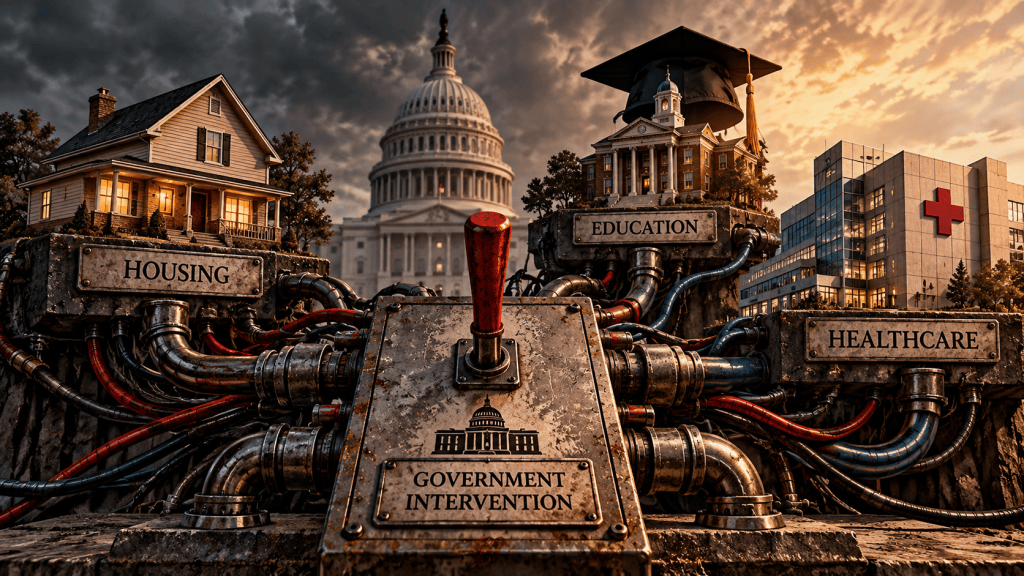
Three of life’s biggest expenses are housing, education, and healthcare. These are three expenses Americans seem incapable of discussing without eventually arriving at the same proposed solution:
Government needs to make it affordable.
Do they, though?
There is an obvious question that should come before any discussion of what the government needs to do next:
Before we muck up the water trying to fix this, are we already fucking it up?
I started looking into these three sectors with a fairly straightforward hypothesis:
Government intervention is the primary driver of excessive price growth in healthcare, housing, and higher education.
I already believed it was probably true. That’s exactly why collecting evidence supporting it wouldn’t tell me much.
Confirmation bias is pretty easy when you already know what answer you’re looking for.
So instead, I tried to beat the shit out of the hypothesis.
Look for evidence against it. Look for other explanations. Find examples where government intervention lowered prices. Find examples where deregulation didn’t.
If the hypothesis survived, great.
If it didn’t, change it.
It took some punches.
Education: The Slam Dunk?
Higher education seemed like the slam dunk for my original hypothesis.
My objection obviously isn’t to Americans having access to education. Nor am I arguing that the only education worth pursuing is one with a monetary reward attached to it.
I’ve read a ton of Stoicism and history. That knowledge has value to me. Nobody is paying me for knowing what Epictetus thought or why the Western Roman Empire collapsed, though, so going heavily into debt to formally study either doesn’t track logically.
Even that isn’t really my business if somebody else wants to do it.
If I want to borrow $100,000 to study Roman history and a private lender wants to risk its own $100,000 financing me, that’s between me and the lender.
Taxpayer-backed financing is a different debate.
In an ordinary lending market, somebody asking to borrow $100,000 creates an obvious question:
How likely am I to get my money back?
That creates discipline.
Federal student lending weakens that feedback mechanism.
Universities aren’t behaving irrationally.
They’re responding to their incentives.
Programs expand. Administration expands. Amenities expand. Credentials proliferate.
The institution gets paid today. Whether the education was worth its price is a problem for the student and taxpayer tomorrow.
At first glance, that’s about as clean a confirmation of my hypothesis as I could have asked for.
Except I was supposed to be trying to disprove it.
And there were countervailing trends.
State appropriations can reduce the tuition students pay, and declining state support explains part of the increase at public universities. Net tuition has also risen considerably less dramatically than some sticker-price comparisons suggest.
I couldn’t substantiate the stronger claim that government intervention explains most of the increase in higher-education costs.
So where did that leave the hypothesis?
The mechanism survived. The magnitude didn’t.
Housing: A Tough Round
Housing is a tougher round, but I think the scorecard ultimately leans my way.
We’ve been making housing for about as long as we’ve been keeping history.
People want someplace to live.
Contractors want to build housing.
Landowners want to develop their property.
Government often tells them:
Nah.
Or sure, but the lot has to be this big. The building can only be this tall. You need this much parking. You can’t put multiple units there. You need approval from these departments. Your neighbors get a say. Come back in eighteen months.
Some of this is legitimate.
There’s a portion of people that would happily make your house out of breadsticks and skip town before it rains if there were no building codes.
I’m not arguing zoning and regulation have no legitimate purpose.
The problem is that, like many legitimate powers granted to government, the purview expands.
Protecting people from genuine externalities becomes protecting homeowners from change.
Minimum lot sizes, density restrictions, parking requirements, height restrictions, lengthy permitting and single-family zoning don’t merely regulate how housing gets built.
They determine how much housing can exist at all.
Research consistently finds restrictive land-use regulation reduces construction and contributes to higher prices, particularly in high-demand markets.
There’s a property-rights problem underneath the economics too.
I bought my house when the surrounding area was relatively rural and undeveloped. Development has since made its way toward me.
I liked it better before.
Too bad.
I bought my property. I didn’t buy the neighboring parcels.
Buying a house shouldn’t also purchase a government-enforced veto over property you don’t own.
Then we get to the fun part.
Government restricts supply, watches housing become more expensive and decides:
Government needs to do something about housing prices.
Subsidize buyers. Subsidize renters. Control rents.
Often while leaving the restrictions making housing scarce untouched.
San Francisco’s rent-control expansion provides a useful example. It helped protected tenants.
It worked for them.
It also encouraged landlords to remove rental units from the market, reducing supply and contributing to higher rents elsewhere.
Both things can be true.
Institutional ownership was another place I expected an easy win.
It wasn’t.
Large institutional investors aren’t large enough nationally to explain America’s housing crisis, though they can matter considerably in specific markets.
The more fundamental problem is scarcity.
Before subsidizing demand, allow supply to respond.
Remove unnecessary restrictions. Speed permitting. Allow greater density where there’s demand for it.
Keep the building codes that prevent my house from dissolving during the first thunderstorm.
Then see what affordability problem remains.
I’m not categorically opposed to temporary help for first-time buyers. But giving buyers another $20,000 while restricting construction risks simply giving them more money to bid against each other.
That’s not solving scarcity.
It’s financing it.
Housing came much closer to vindicating my original hypothesis, though I still couldn’t prove government intervention was the primary cause nationally.
Tough round. On my scorecard, the hypothesis won it.
Healthcare Punches Back
Then healthcare punched a hole in it.
I’ve already covered the history in greater detail in The Gordian Knot of Healthcare, so I’ll keep this short.
World War II wage controls encouraged employers to compete through benefits. Favorable tax treatment entrenched employer-sponsored insurance. Third-party payment separated consumers from prices. Medicare, Medicaid and reimbursement rules added layer after layer.
Government is nowhere near an innocent bystander.
But then comes consolidation.
Hospitals consolidate. Physician practices consolidate. Insurers consolidate. Market power allows providers to demand higher prices.
I could have explained all of that away as another downstream effect of government.
The evidence wouldn’t let me.
Government policy encourages some consolidation, but private actors are perfectly capable of accumulating and exploiting market power themselves.
Medicare provided another problem.
It can pay substantially less than commercial insurers for similar services. My first instinct was that providers simply shifted the difference onto privately insured patients.
The evidence for broad cost shifting isn’t particularly good. Provider market power appears to explain considerably more.
That’s a concession.
Sometimes government-administered prices are lower than privately negotiated ones. Sometimes private markets fail to remain meaningfully competitive.
That’s where government has a legitimate role as referee.
Protect rights. Punish fraud. Address genuine externalities. Preserve competition. Break monopolies where necessary.
Healthcare didn’t destroy the government-distortion argument.
It destroyed the idea that the argument explained everything.
Looking for More Trouble
If I’m going to argue government intervention drives prices higher, I also have to look honestly at the times it hasn’t.
And those examples exist.
Generic drugs are a good one.
Government created a pathway allowing generic manufacturers to demonstrate equivalence without reproducing every expensive step undertaken by the original manufacturer.
More competitors entered. Prices fell dramatically.
That’s government intervention.
But notice what kind.
It reduced a barrier to competition.
Government maintained safety standards while making it easier for additional producers to enter the market.
Medicare pricing remains a harder counterexample. Government-administered prices can be lower than privately negotiated ones.
Deregulation doesn’t guarantee lower prices either.
Markets don’t guarantee painless outcomes.
That’s not why I prefer them.
Freedom isn’t preferable because it’s safest. It’s preferable because it grants the widest latitude to individuals.
Failures contain information.
Businesses fail. Investors lose money. Lenders make bad loans.
The feedback mechanism matters.
Government becomes particularly dangerous when it separates decisions from consequences—guaranteeing the loan, subsidizing the price, protecting the incumbent, restricting the competitor and then regulating the resulting distortion.
At some point, the original market signal disappears underneath all the corrections.
Refine the Hypothesis
At this point, the original hypothesis was overstated.
Not completely unfounded.
Government policy restricts housing supply. Federal financing contributes to tuition increases. Tax and reimbursement policy distort healthcare incentives. Rent controls create unintended consequences.
But that’s not the same as proving:
Government intervention is the primary driver of excessive price growth in healthcare, housing, and higher education.
I couldn’t substantiate that claim as categorically as I expected.
So throw it out.
Or rather, refine it.
That’s what testing a hypothesis is about.
Pick up the pieces that survive the beating.
Something interesting survived.
Every time I found a damaging intervention, I asked why it failed. Every time I found a successful one, I asked what made it different.
That produced a better question:
Before government intervenes to fix a market, is government already contributing to the problem?
A Test for Government Intervention
Maybe government intervention needs an order of operations.
What’s the actual problem?
A rights violation? A genuine market failure? A lack of competition? A real need people can’t reasonably address themselves?
“I don’t like this outcome” isn’t enough.
Are we already contributing to it?
Before subsidizing expensive housing, ask whether government is restricting supply. Before expanding college financing, ask whether existing financing contributes to tuition growth.
What evidence suggests the intervention will work?
Has something similar worked elsewhere? If not, admit we’re conducting an experiment.
What does success look like?
Define a measurable goal before implementing the policy.
What else happened?
Measure unintended consequences as seriously as intended ones.
How do we get out?
Sunset clauses. Conditional sunsets. Mandatory reassessment.
If it worked and the problem is solved, stop. If it isn’t working, change it. If it’s making things worse, kill it.
Government intervention shouldn’t become permanent simply because government intervened once.
Measured. Surgical. Temporary.
Why Temporary Matters
This is where my disagreement with a lot of people becomes more philosophical than economic.
A lot of people seem to believe that with enough intervention, enough expertise and enough control, we can eventually engineer something approaching utopia.
I don’t.
Not because markets produce utopia.
They don’t.
I don’t think utopia is available.
And I especially don’t want a government powerful enough to manufacture one.
Because then we depend on whoever has their hand on the switch.
You can democratically vote enormous power into government. That doesn’t mean you’ll have an equally easy time voting it back out.
Institutions develop bureaucracies, constituencies and political interests around the authority they possess.
Government is generally not good at rescinding power once it is no longer needed.
We don’t have many Cincinnatuses among us.
The Roman story is useful precisely because Cincinnatus is remarkable. He was granted extraordinary authority during a crisis and relinquished it when the crisis had passed.
That’s the ideal.
It’s also a terrible assumption on which to build a government.
We all hope the person entrusted with power will be Cincinnatus.
History suggests ambition is considerably more common.
Caesar. Marius. Sulla.
Even Sulla eventually surrendered the dictatorship, but only after using extraordinary power to fundamentally reshape Rome and eliminate his enemies.
Relinquishing power is not the same thing as relinquishing its consequences.
Good institutions shouldn’t depend upon unusually good people.
They should be designed with the understanding that eventually someone ambitious, self-interested, convinced of their own necessity—or simply unwilling to surrender what they’ve acquired—will be sitting in the chair.
Reverse the Burden of Inertia
This is why temporary authority matters.
A sunset clause doesn’t prevent government from continuing something necessary.
It changes who has to expend political will.
When an intervention is designed to expire, political will must be expended to continue it.
When an intervention has no expiration, political will must be expended to end it.
The first federal income tax provides an interesting example.
The Civil War created an extraordinary financial need, and the income tax was enacted with an expectation that it would end. Congress extended it when necessary, but lawmakers repeatedly had to decide whether the authority should continue.
Eventually, they let it expire.
The modern income tax returned without that same expectation. Initially affecting a relatively narrow portion of Americans, its reach has expanded enormously across the American economy.
The point isn’t that taxes are inherently illegitimate.
The point is institutional.
Political inertia has a direction.
Without an exit mechanism, doing nothing preserves government authority.
With one, doing nothing returns authority.
That doesn’t require politicians to be Cincinnatus.
It requires them to actively justify why the power should remain.
And that’s where I think the burden should be.
What Survived
The hypothesis I ended with looks considerably different from the one I started with:
Government intervention isn’t inherently destructive, nor are markets inherently self-correcting. But intervention should bear a burden of proof. Before adding another layer, government should determine whether existing policy is contributing to the problem. If further intervention is warranted, it should address a clearly identified problem through an evidence-based mechanism, have measurable goals, be evaluated against unintended consequences, and contain a mechanism for revision or exit.
That’s less satisfying than:
Government screwed everything up.
It’s also much harder to knock down.
I started this exercise expecting to demonstrate that government was primarily responsible for three of America’s largest affordability crises.
I couldn’t.
The evidence supported pieces of that hypothesis and exposed holes I couldn’t honestly fill.
Good. That’s what testing a hypothesis is supposed to do.
Pick up the pieces that survived the beating.
We don’t need to assume government caused every problem. We don’t need to assume markets will solve every problem.
But we should stop treating the desire to intervene as evidence that intervention will help.
Establish the problem.
Ask whether we’re already contributing to it.
Intervene when there’s a genuine need.
Do it narrowly.
Measure what happens.
Be willing to admit when it failed.
And have a way out.
Measured. Surgical. Temporary.
Because I don’t want my freedom—or yours—to depend on hoping that whoever gets their hand on the switch turns out to be Cincinnatus.
Before we ask government to fix the problem, are we already fucking it up?
Mic G


Leave a Reply